 AccPilot
Petty cash voucher template (free Excel) and how to use it
Free petty cash voucher template in Excel, with a petty cash book. How the float and vouchers work, what each needs, and a worked RM top-up.
Every small client has a petty cash tin. Parking, courier, a box of A4 paper, drinks for the OT night. Small amounts, paid in cash, every week.
At month-end the firm gets the result: a bundle of crumpled receipts, a few handwritten notes, an envelope with some cash left, and a client asking why the balance doesn’t agree. Somebody at the firm then sorts the slips by date, glues them onto A4, photostats the faded ones, and keys every line in. For RM12 of parking.
Petty cash is small money, but it is a lot of paper. A simple voucher system keeps it tidy for the client and keeps the month-end short for the firm.
Free petty cash voucher template (Excel)
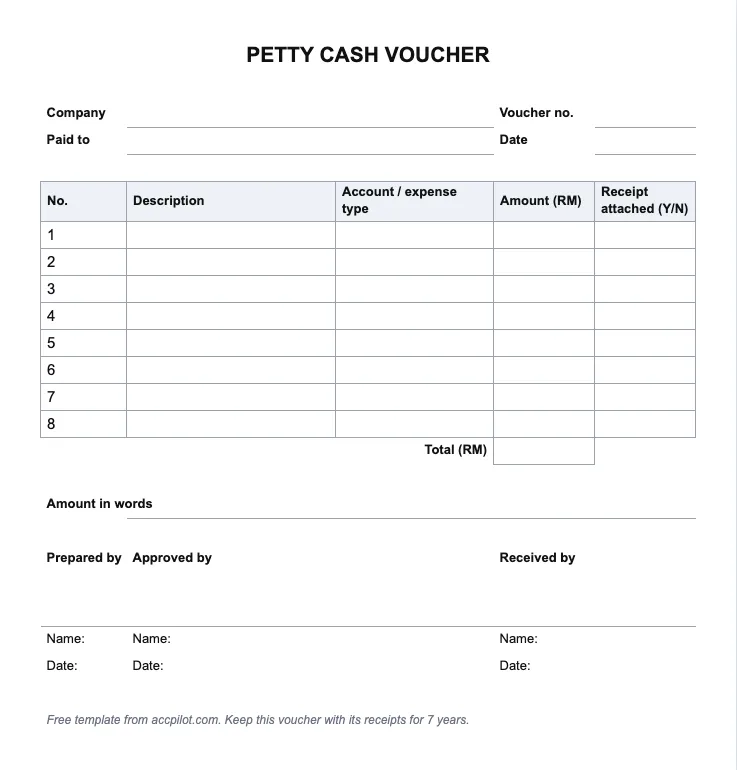
Download the petty cash voucher template (Excel). One page, ready to print or fill in on screen. The rest of this guide explains each part.
What petty cash is
Petty cash is a small amount of cash kept on hand for minor business spending that is not worth a cheque or bank transfer. One person, the petty cash custodian, holds it and is responsible for it.
Most firms set clients up on the imprest system:
- The client fixes a float, say RM500.
- Every payment out of the tin is recorded on a petty cash voucher, with the receipt attached.
- At any time, cash in the tin + total of vouchers = the float.
- When the cash runs low (or at month-end), the client tops up by exactly the total of the vouchers, bringing the tin back to RM500.
The float only changes when the boss decides it should. Everything else is replacing what was spent.
What a petty cash voucher is
A petty cash voucher is the client’s own internal record of one payment out of petty cash. It is not the supplier’s receipt. It sits on top of the receipt and explains it: who took the money, what for, how much, and who approved it.
It matters most when the receipt is weak or missing. A parking meter that gave no slip, a handwritten receipt from a hawker, a thermal slip that will be blank in a year. The voucher records the spending in the client’s own words, signed by the person who took the cash.
A voucher is not a substitute for a receipt where one exists. For anything more than small change, get the receipt, attach it, and keep both.
What goes on a petty cash voucher
Keep it to one page and the same layout every time:
- Date of the payment
- Voucher number, running in sequence (PCV-0001, PCV-0002 …), so a missing voucher shows up as a gap
- Paid to (the payee, or the staff member who was reimbursed)
- Description of what was bought and why
- Amount in RM
- Account the cost goes to (postage, travel, office supplies, staff welfare)
- Receipt attached: yes or no. If no, write the reason.
- Signatures: prepared by, approved by, received by
Download the petty cash voucher template (Excel). It has these fields laid out on one page, ready to print or fill in on screen.
Running it, step by step
- Set the float. Agree an amount that covers about a month of small spending. Write it down as the opening petty cash balance in the books.
- One voucher per payment. Fill it in when the cash goes out, not at month-end from memory.
- Attach the receipt. Staple or clip it to the voucher. If it is a thermal slip, take a clear photo the same day, before it fades.
- Get the approval signature. Someone other than the custodian, for anything above a limit the client sets.
- Count the tin regularly. Cash plus vouchers should equal the float. Any difference gets found the same week, not at year-end.
- Top up and record. When the client tops up, total the vouchers by account and post one entry: debit each expense account, credit bank.
- Keep the vouchers and receipts. They are supporting documents for the expenses, and business records must be kept for 7 years under section 82 of the Income Tax Act 1967. LHDN explains what counts as sufficient records in its public rulings, such as Public Ruling 4/2000 for companies. More in how long to keep receipts in Malaysia.
A worked example
A made-up client keeps a RM500 float. During October the custodian pays out six vouchers:
| Voucher | Description | Account | RM |
|---|---|---|---|
| PCV-0101 | Parking, client visit | Travel | 12.00 |
| PCV-0102 | Courier, documents to bank | Postage and courier | 45.00 |
| PCV-0103 | A4 paper and toner | Office supplies | 86.50 |
| PCV-0104 | Drinking water refill | Pantry | 38.00 |
| PCV-0105 | Dinner for staff on OT | Staff welfare | 62.80 |
| PCV-0106 | Stamps | Postage and courier | 24.00 |
| Total vouchers | 268.30 |
The tin should hold RM500.00 − RM268.30 = RM231.70. The count on 31 October finds RM226.70. RM5.00 is short.
The custodian can’t explain it, so the boss approves writing it off as a cash shortage. The top-up brings the tin back to the float: RM500.00 − RM226.70 = RM273.30.
The entry for the top-up:
| Account | Debit RM |
|---|---|
| Travel | 12.00 |
| Postage and courier | 69.00 |
| Office supplies | 86.50 |
| Pantry | 38.00 |
| Staff welfare | 62.80 |
| Cash shortage | 5.00 |
| Credit: Bank | 273.30 |
The tin is back at RM500, the expenses are in the right accounts, and the RM5.00 is visible instead of hidden.
Common problems the firm sees
- IOUs in the tin. A staff member “borrows” RM50. It is not an expense and should not sit in petty cash. Treat it as a staff advance or keep it out of the tin.
- Personal spending mixed in. The boss’s family groceries paid from petty cash. Ask, and post it to the director’s account, not to office expenses.
- Vouchers written at month-end. Twenty vouchers in the same handwriting, same pen, same day. The amounts are guesses. Push for one voucher per payment, when it happens.
- Faded receipts. Thermal slips in the tin for a month come out blank. A photo the day it is paid is enough to keep it readable.
- Petty cash used for big payments. Anything a supplier will invoice should go through the bank with a payment voucher, not out of the tin.
Where AccPilot fits
The voucher is the client’s job. The receipts behind it are where the firm loses time: sorting them, gluing them, keying each one. With AccPilot the client or the custodian snaps the receipts with their phone, or sends them through the client upload link, the day they are paid. AccPilot reads the vendor, date, amount and tax, marks each one Ready or Check with the reason, and remembers which account each supplier usually goes to. The firm exports one Excel into its accounting software, and every receipt stays stored and searchable by vendor, date and amount for 7 years.
What stays with the firm: checking the count, deciding what a shortage or a personal payment really is, and posting the top-up. AccPilot does not run the petty cash tin or produce the vouchers. It takes the keying and the gluing out of the month-end; the original receipts still go into the month’s envelope. See how to get client receipts without chasing.
To see it on a real month of a client’s petty cash receipts, book a free demo.